
Quotes
⚠️
Content Warnings: Mentions of female reproductive organs and descriptions of FGC.
In Singapore, there are five doctors (who we know) who perform FGC in five different GP clinics across the country. In Malaysia, where there are hundreds of doctors who perform FGC, there are more studies being done on how FGC is practiced.
Why are there no comprehensive studies done for the practice in Singapore?
Here’s why:
In an email correspondence with End FGC Singapore, Singapore’s Ministry of Health had this to say,
The practice of ‘sunat’ by the Malay community in Singapore is not prevalent. It is a private and long-standing custom that some have chosen to practise.
This response raises a few questions:
- If FGC is a “long-standing custom”, how did MOH decide that the practice “is not prevalent”? Isn’t there a contradiction here?
- How does MOH define ‘prevalence’?
- Why does MOH classify FGC as “private”? What does this mean of MOH’s regulation or monitoring of such practices? That because it’s “private” that MOH will not ‘meddle’ in ‘minority affairs’?
According to MOH’s said response as well as results from our pilot study (2020)*, we can imply that FGC procedures in Singapore are
- not standardised
- not regulated
- not monitored
either by the MOH or the Muslim Healthcare Professionals Association (MHPA). EFS’ attempts to engage with MOH to learn more about how doctors perform FGC have elicited no productive responses.
With very little to nothing for us to go on to know how Singaporean doctors perceive FGC and why they perform it, we look to studies done in Malaysia, whose practices may not be too different from ours (in terms of history, culture and religion).
We refer to a study, “Medicalisation of female genital cutting in Malaysia: A mixed methods study” (Abdul Rashid et al., 2020), to learn more about how doctors understand FGC and why they perform it.
Of the 362 doctors who were willing to be surveyed, 20% of them perform FGC. Let’s see the reasons for why they do so.
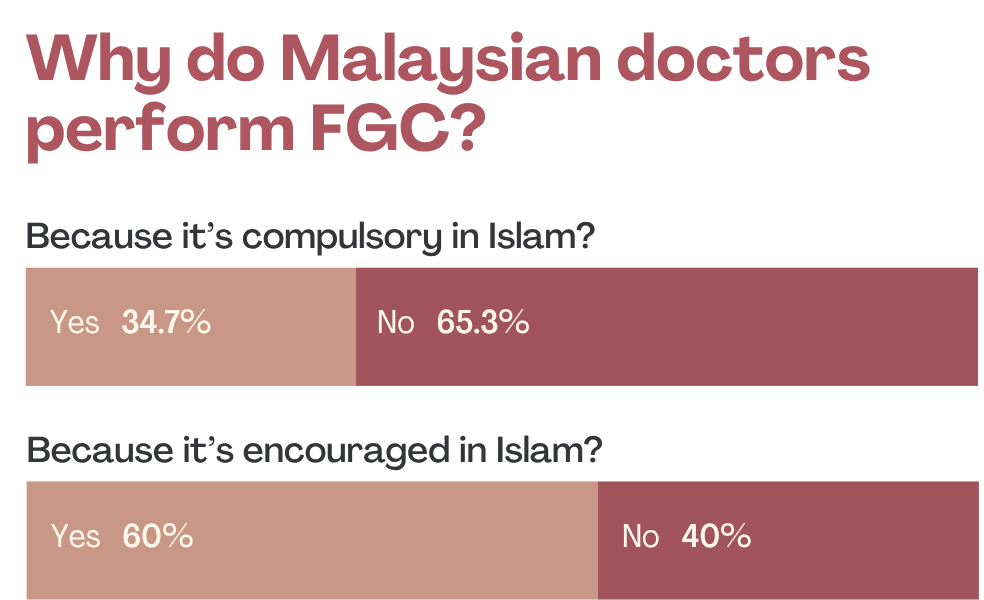
Like the majority of Muslims in Singapore, Muslims in Malaysia follow the Shafi’i mazhab (school of thought), whose jurisprudence states that khitan (FGC) is wajib (compulsory) in Islam.
It is interesting, therefore, that while 60% think that FGC is encouraged (or sunnah), more than that don’t find it compulsory, though they still provide the service.
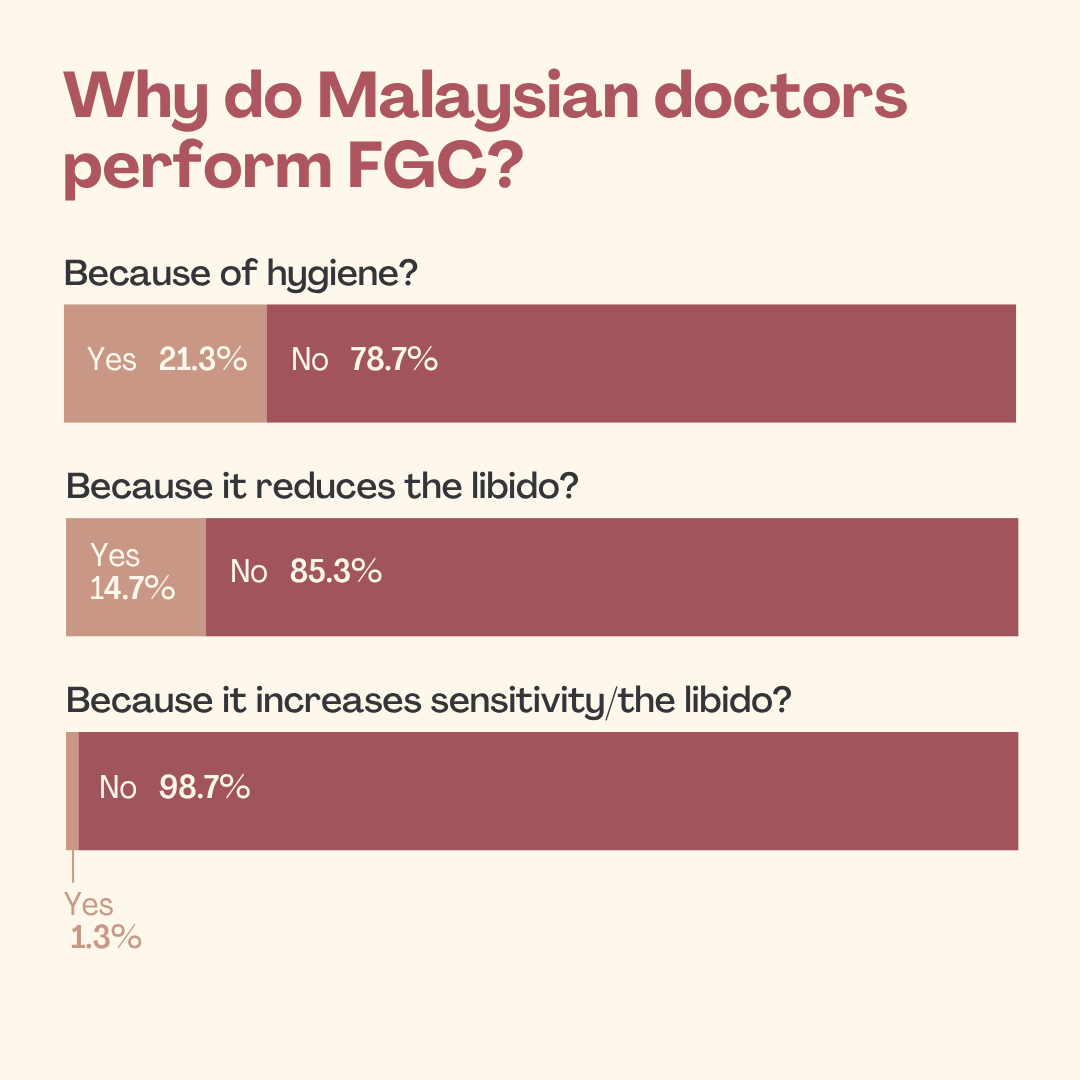
Again, the high % of “No’s” to these questions are surprising, especially when they are commonly used reasons by Muslims in both Malaysia and Singapore for practising FGC.
In-depth interviews with a number of the doctors shed more light into how they understand FGC practices.
Strikingly (and scarily), though their primary reason to perform FGC is religious, and other times cultural, doctors couldn’t really explain why. They “just do it”.
Being a Muslim, I believe it is a religious obligation, but I am not sure if it is wajib [mandatory]...but I believe in my religion and deep inside I believe we have to do it. Because there are certain things you cannot see, you cannot understand... You just follow.
You know there is [a] demand for it because of religion, I have to do it, I am a medical professional, but I still have to do and there is no other reason for it. If the [parents] want [it], we just do it...
[Medical benefit?] I can’t tell you... I don’t think I can find one.
Because of the culture, I think it is difficult to change... If the doctors stop doing and culture requires it done, where will [parents] go and what will happen?
We can draw some conclusions from how doctors perceive and rationalise the(ir) practice of FGC.
- Most doctors don’t actually know why they practise FGC. They refer to religion and culture as reasons, but they don’t–or cannot–give detailed explanations as to why.
- Most doctors don’t believe that there is anything medically beneficial about FGC. As we’ve observed, most don’t find that FGC helps with one’s genital hygiene.
- Most doctors find that medicalised FGC ensures that the practice is done safely.